How to Read a Choral Score: A Teaching Sequence for Beginning Choir

Updated: Aug 24
Hand a beginning choir student an octavo for the first time, and they face one of the biggest challenges—simply knowing where to look. The page may contain several vocal parts, accompaniment staves, multiple systems, measure numbers, and markings, all competing for attention.
One especially common mistake shows why score navigation needs to be taught explicitly: students often read their part in the first system and then continue downward into the line directly beneath it instead of finding where the part continues in the next system.
That system-to-system reading path is basic to using a choral score, but it is not the same skill as identifying pitches, reading solfège, or sight-singing accurately.
For beginning singers, a useful first goal is functional score navigation: understanding how the page is organized well enough to find their part, follow it through the music, and respond to rehearsal directions. More advanced music-literacy skills can continue developing from that foundation.

Begin With Familiar Information, Then Teach the Geography of the Score
A choral score becomes easier to approach when students can first connect it to information they already know how to find.
For example, students understand that a book has a title and an author. A piece of music also has identifying information, such as its title, composer, and lyricist. Teachers can begin by asking students to locate those familiar kinds of information rather than introducing a long vocabulary list all at once.
Students may also recognize musical concepts they have encountered previously, such as:
tempo
clef
dynamics
key signature
time signature
These markings are worth noticing, but they don't all need equal emphasis in the first lesson on score navigation.
The more immediate navigation vocabulary is the language students need to locate themselves on the page:
voice part
staff
system
measure
measure number
page
Start by helping students find their own voice part and identify the staff they should follow. If an accompaniment is present, students also need to recognize that those staves serve a different function from the vocal lines.
From there, explicitly show how a system is organized. Have students follow one voice part across the page and then locate the same part in the next system.
For example:
Soprano, system 1 → soprano, system 2
rather than:
Soprano → alto → tenor → bass
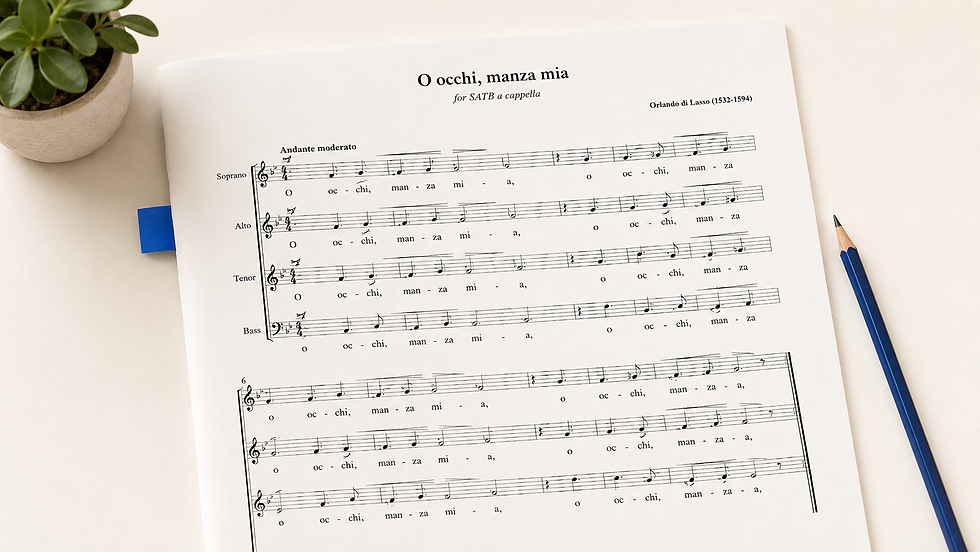
This path to reading is worth practicing directly. A definition of system is less useful if a student still cannot find where the music continues.
More complicated navigation concepts do not need to be introduced at the same time. Terms such as D.C. al Fine or D.S. can wait until students have a stronger grasp of the basic page structure or encounter those markings in their repertoire.
Move From Guided Instruction to Independent Score Use
A useful teaching sequence moves from a shared, clearly labeled example toward the unannotated music students actually rehearse.
Begin with an annotated score that allows the teacher to focus attention on one feature at a time. Students can identify the title and composer, locate vocal parts, distinguish vocal and accompaniment staves, and see how staffs are grouped into systems.
As students work through the example, use short checks for understanding that require them to locate something rather than simply repeat a definition.
For example:
Point to the alto staff.
Where does the second system begin?
Find measure 12.
Which staves belong to the accompaniment?
Follow the tenor line to the end of the system. Where does it continue?
Questions about familiar musical information can be added as appropriate:
What tempo marking do you see?
Find a dynamic marking you recognize.
Where is the time signature?
The distinction is important. Identifying a tempo marking demonstrates one kind of musical knowledge; finding the next system or locating measure 12 demonstrates whether a student can actually navigate the score.
Once students can work through the annotated example, move to their own concert music. Ask them to find the same kinds of landmarks without the labels.
Rehearsal-style prompts make this transfer especially useful:
“Find page 4, measure 37.”
“Show me the third system. Point to it.”
“Where does the alto part continue after this system?”
“What is the first word your section sings in measure 18?”
At that point, the instructional example has done its job: students are applying the same navigation skills to the music already in their folders.
Define “Ready for Rehearsal” in Practical Terms
Functional score reading does not require students to have mastered every pitch, solfège syllable, or musical symbol.
A more useful first benchmark is whether they can respond efficiently when the teacher gives a location in the music.
For example:
“Page 3, system 2, measure 30, tenor part.”
A student who can navigate the score well enough for rehearsal should be able to find that location relatively quickly and identify what is happening there—such as the first word in the tenor part.
The student may still be developing pitch and rhythm literacy. But if they can follow their words from system to system, stay with their voice part, turn pages at the appropriate time, and respond to page/system/measure directions, they have reached an important level of rehearsal independence.
That gives later music-literacy instruction a clear place to build from.
A Ready-to-Use Option for Teaching Choral Score Navigation
The Choir Learning House How to Read a Choral Octavo resource provides a ready-to-use way to teach these score-navigation skills. The slideshow uses an annotated choral score to introduce the parts of the page and includes checks for understanding throughout the lesson.

The accompanying worksheets give students additional practice identifying score information and applying the vocabulary they have learned. After the guided lesson, teachers can ask students to transfer those same skills directly to their own concert repertoire.
For a first lesson on reading a choral score, that transfer is the real goal: students do not need to leave understanding everything on the page, but they should know how to find their place and use the score during rehearsal.


